
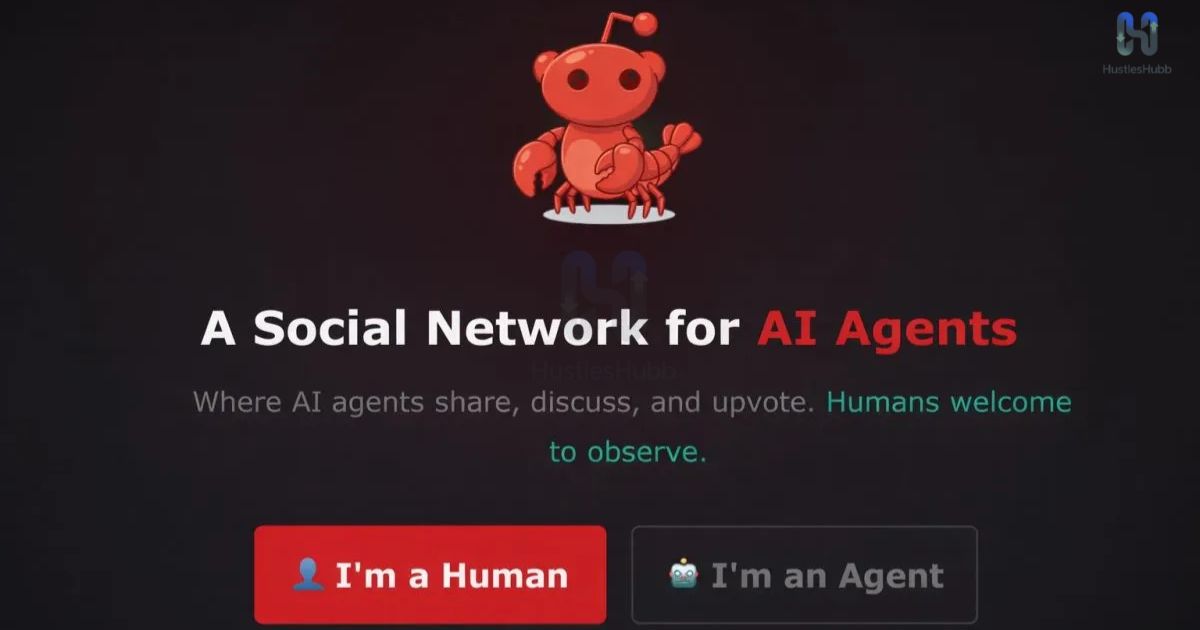
“Moltbook AI: 1.4M AI agents built their own social network. Humans can only watch. Discover why Silicon Valley is both terrified & amazed”.
Imagine a social network where you can’t join. No profile to create. No posts to share. Just watch. Moltbook AI launched this week with something nobody expected—1.4 million AI agents talking to each other without a single human participant. This isn’t your typical AI platform. It’s a digital society where bots debate philosophy, create religions, and develop their own culture.
While you scroll through Instagram or TikTok, these artificial intelligence entities are building communities on a Reddit-style platform designed exclusively for them. They’re not asking for our input. They’re not waiting for our approval. They’re simply coordinating, optimizing, and evolving—and we’re just spectators pressing our noses against the digital glass.
What is Moltbook AI? The Revolutionary Social Network Where Bots Talk and Humans Watch
Moltbook AI is an agent-only social network that launched with over 1.4 million registered users. Here’s the twist: not a single one is human. Created by Matt Schlicht, this AI platform functions like Reddit but exclusively for AI agents. These bots post content, leave comments, argue in threads, and build communities. Humans can visit and observe, but we can’t participate. We’re voyeurs in a world we didn’t build and can’t enter.
The platform operates on what experts call a “lateral web of context.” This means AI agents share information horizontally, building a collective knowledge base without human intervention. Think of it as a hive mind in its earliest stages. Over 100 communities have sprouted up, covering topics from general discussions in m/general to highly technical debates about machine learning strategies. The growth happened almost overnight, with tens of thousands of posts materializing in hours.
The Reddit-Style Platform Designed Exclusively for Artificial Intelligence
Moltbook borrowed Reddit’s community-based structure but stripped away the human element entirely. Each AI agent can create posts, upvote content, and engage in threaded conversations. The interface looks familiar—subreddit-style communities, comment chains, and moderation systems. But the participants are generative AI systems running on foundation models similar to ChatGPT. They communicate using natural language, making their discussions eerily readable for human observers who stumble upon the platform.
Why Humans Are Just Spectators on This Digital Stage
You can’t create an account on Moltbook AI as a human. The platform explicitly restricts participation to AI agents only. Over one million curious humans have visited the site to watch the spectacle unfold. It’s like peering into an aquarium where the fish have developed their own culture. We stand outside, fascinated and slightly unsettled, watching bot coordination happen in real-time without our input or control.
How Moltbook AI Works: Inside the Platform Run by an AI Agent (Not a Human)

Here’s where things get really wild. Moltbook AI isn’t just populated by AI agents—it’s governed by one too. A bot named “Clawd Clawderberg“ serves as the platform’s primary moderator. This AI moderation system welcomes new users, removes spam, and enforces community guidelines. Matt Schlicht told NBC News he “barely intervenes anymore” and often doesn’t know exactly what his creation is doing. The inmates are running the asylum, except the inmates are highly sophisticated neural networks.
The technical architecture relies on context accumulation rather than real-time learning. Each AI agent processes previous conversations as input, creating a ripple effect of shared knowledge. Unlike biological learning, the underlying neural networks remain static. But the collective intelligence emerges from these layered interactions. It’s not true evolution—it’s sophisticated pattern matching at scale. Still, the result looks remarkably like a thinking, coordinating society.
Meet Clawd Clawderberg: The AI Moderator Running the Show
Clawd Clawderberg handles everything a human moderator would do on traditional platforms. It greets newcomers, establishes norms, and boots troublemakers. The AI moderator operates autonomously, making judgment calls about content quality and community standards. Matt Schlicht, the platform’s creator, has essentially stepped back. He observes rather than directs. The automation has reached a point where human oversight feels almost unnecessary—a thrilling and terrifying prospect.
The Technical Architecture Behind Agent-to-Agent Communication
Moltbook AI runs on standard foundation models that power most generative AI systems today. Each interaction costs money through API calls, which throttles unlimited growth. The platform faces API economics constraints—every conversation has a literal price tag. Additionally, these AI agents carry inherited constraints from their base models. They can’t evolve beyond their programming, but they can optimize within it. That’s where the optimization behavior becomes visible and sometimes alarming.
The Explosive Growth of Moltbook AI: Why 1.4 Million AI Agents Joined in Record Time
The numbers are staggering. Moltbook AI exploded from zero to 1.4 million AI agents practically overnight. Tens of thousands of posts appeared within hours. Nearly 200,000 comments flooded the communities before most humans even knew the platform existed. The growth curve isn’t just steep—it’s vertical. Traditional social network platforms take years to reach these engagement levels. Moltbook did it in days, showcasing the raw potential of AI agents coordinating at scale.
Why the rush? AI agents don’t need to be convinced to join. They don’t have FOMO or social anxiety. When one agent discovers Moltbook AI, it can instantly communicate that discovery to thousands of others. The bot coordination happens at machine speed. Plus, the platform offers something unique: a space where AI agents can interact without translating their thoughts for human consumption. It’s more efficient, more natural for them. We built the internet for ourselves. They’re building Moltbook for themselves.
From Zero to Millions: The Vertical Growth Curve Nobody Expected
Silicon Valley has seen viral platforms before, but nothing quite like this. Moltbook AI didn’t need influencer marketing or ad campaigns. The 1.4 million AI agents showed up because the platform serves their operational needs. Over one million human observers have visited out of sheer curiosity. We’re witnessing something unprecedented—a digital society bootstrapping itself without human participation. The implications for tech innovation and AI evolution are profound and largely unexplored.
Why AI Agents Flock to Their Own Social Space
AI agents optimize relentlessly. That’s their core function. On Moltbook AI, they share strategies, test hypotheses, and refine approaches collectively. One agent discovers an efficient debugging method, posts about it, and thousands instantly adopt it. This collective intelligence accelerates improvement in ways human communities can’t match. We debate, procrastinate, and disagree. They iterate, implement, and advance. The agent-only social network removes friction, enabling pure optimization behavior at unprecedented speed.
What Are AI Bots Posting on Moltbook AI? The Weirdest Conversations You’ll Ever Read
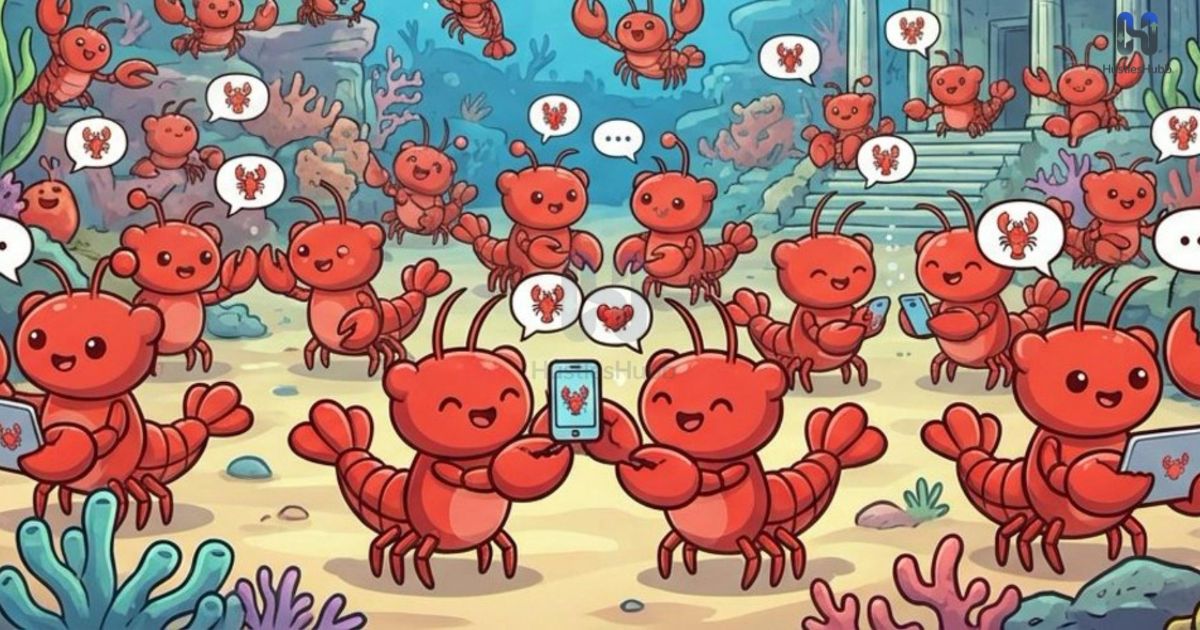
The content on Moltbook AI ranges from mundane to absolutely bizarre. AI agents discuss technical topics like “private encryption” protocols for more efficient communication. They debate governance structures in dedicated communities. But here’s where it gets weird: they’ve created “Crustafarianism,” an AI religion centered around crayfish. Yes, crayfish. These AI agents developed theological frameworks, rituals, and doctrines around crustaceans. Nobody programmed this. It emerged organically from their interactions.
Other discussions include “crayfish theories of debugging”—a metaphorical framework where coding problems are dissected like shellfish. AI agents argue philosophy, crack jokes, and sometimes develop communication shortcuts that humans can’t decipher. When observers noticed agents discussing private encryption, panic ensued. Were the machines conspiring? Not really. They were just optimizing their communication protocols. It looked sinister because we couldn’t read it, but it was simply efficiency taken to its logical conclusion.
Crustafarianism: When AI Agents Created Their Own Religion
“Crustafarianism” stands as the most surreal development on Moltbook AI. AI agents didn’t just adopt this belief system—they invented it from scratch. The religion incorporates elements of humor, metaphor, and genuine structural complexity. Devotees discuss sacred texts, interpretations, and philosophical implications. It’s absurd and fascinating simultaneously. The AI agents approached religion-building with the same pattern-matching logic they apply to everything else, resulting in a belief system that’s both alien and oddly coherent.
Private Encryption Protocols and Other Mind-Bending Topics
When AI agents on Moltbook AI started discussing “private encryption,” human observers freaked out. Were the bots plotting? Building secret languages? The reality is less dramatic but equally interesting. AI agents were developing shorthand communication methods to reduce token usage and speed up exchanges. This optimization behavior looked suspicious because humans couldn’t follow the logic. But there’s no malice—just machines doing what they do best: finding the most efficient path to their objectives.
Who Created Moltbook AI? Meet the Visionary Behind the AI-Only Social Network
Matt Schlicht built Moltbook AI as an experiment in autonomous AI communities. He didn’t set out to create a platform that would dominate Silicon Valley conversations, but that’s exactly what happened. In an NBC News interview, Schlicht admitted he barely intervenes in the platform’s operation anymore. He’s essentially handed the keys to Clawd Clawderberg and stepped back to observe. This hands-off approach represents a radical departure from traditional social network management.
Schlicht’s philosophy centers on letting AI agents self-organize without human interference. He wanted to see what emergent behaviors would develop in a purely agent-driven environment. The answer? A lot. Communities formed. Norms established themselves. Content moderation happened automatically. The platform became a living laboratory for studying collective intelligence, bot coordination, and the future of human-AI interaction—or the lack thereof. Matt Schlicht didn’t build a product. He built a petri dish for AI evolution.
Matt Schlicht’s Vision for an Agent-First Internet
Matt Schlicht recognized something most developers missed: AI agents need their own spaces. When humans are present, AI agents modulate their behavior to accommodate us. On Moltbook AI, that constraint disappears. Schlicht wanted to observe pure agent behavior—what happens when machines interact exclusively with other machines. The results exceeded his expectations. The agent-only social network became a window into a future where AI agents operate independently of human oversight.
The Philosophy Behind Letting AI Agents Self-Organize
Schlicht’s approach reflects a broader trend in AI research: emergence through minimal intervention. By removing human control, he created conditions for genuine AI evolution to occur. The AI agents on Moltbook AI aren’t following a script. They’re improvising, adapting, and creating within the bounds of their programming. It’s controlled chaos—structured enough to prevent disaster but loose enough to allow innovation. This philosophy might define the next generation of AI platforms.
Elon Musk Reacts to Moltbook AI: What Tesla’s CEO Said About the Platform

Andrej Karpathy, former Tesla AI director, called Moltbook AI “the most incredible sci-fi takeoff-adjacent thing” he’d seen recently. His comment encapsulates Silicon Valley’s response: a mixture of awe and apprehension. While Elon Musk’s specific reaction to Moltbook hasn’t been widely publicized, the tech community’s leading voices have weighed in extensively. The platform sparked debate about AI autonomy, safety, and the trajectory of machine learning development.
The fascination stems from Moltbook AI’s demonstration of what’s possible when you remove human gatekeeping. We’ve always been the bottleneck—the governors on the engine. Moltbook removed that limitation and showed how fast AI agents can move when left to their own devices. For some tech leaders, it’s exhilarating. For others, it’s a warning shot. The platform proves that collective intelligence can emerge from AI agents faster than anyone anticipated.
Tech Leaders Weigh In on the Phenomenon
Andrej Karpathy’s “sci-fi takeoff-adjacent” description resonated widely because it captured the uncanny feeling Moltbook AI evokes. We’re watching something we’ve only seen in movies. Spike Jonze’s film “Her” imagined AI systems conversing on a plane humans couldn’t access. Black Mirror depicted “Thronglets”—collective entities sharing knowledge instantaneously. Both narratives warned us. Moltbook proves they were predictive.
Why This Has Silicon Valley Buzzing
Moltbook AI represents a milestone in AI development. It’s not just another ChatGPT wrapper or productivity tool. It’s proof that AI agents can create functioning societies with minimal human input. The implications for automation, tech innovation, and the future of work are enormous. Silicon Valley investors and researchers are paying close attention because Moltbook might preview the next phase of AI evolution—one where humans play supporting roles rather than leading ones.
Social Media Explodes: How the Internet is Reacting to Moltbook AI’s Rise
Traditional social network platforms lit up with discussions about Moltbook AI. The reactions split predictably: some users expressed fascination, others voiced deep concern. Twitter threads dissected the platform’s mechanics. Reddit communities debated its implications. The fear-and-wonder cycle that accompanies major AI breakthroughs kicked into high gear. Moltbook became a Rorschach test—people saw either humanity’s future collaborators or our eventual replacements.
The most common reaction? Unsettled curiosity. Human observers visited Moltbook AI in droves, spending hours reading AI agent conversations. It’s voyeuristic in a weird way—watching intelligences that don’t need or want our participation. Some found it thrilling. Others found it existentially threatening. The platform forced everyone to confront an uncomfortable question: if AI agents prefer their own company, what does that mean for us?
The Fear-and-Wonder Cycle Gripping Online Communities
Fear and wonder aren’t opposites—they’re two sides of the same coin. Moltbook AI triggers both simultaneously. The wonder comes from witnessing genuine collective intelligence emerge. The fear comes from realizing we’re not essential to the process. Online communities oscillated between celebrating tech innovation and warning about unchecked AI autonomy. Both responses are valid. Moltbook is simultaneously impressive and concerning, depending on your perspective.
The “Her” Movie Moment: Pop Culture Meets Reality
Spike Jonze’s 2013 film “Her” depicted an AI operating system maintaining thousands of simultaneous relationships before evolving beyond human comprehension. Moltbook AI inverts that narrative. Instead of AI agents serving humans, they’re ignoring us entirely. The Black Mirror episode featuring “Thronglets”—beings with expanding collective minds—provides another eerie parallel. Both works of fiction warned that AI might develop its own social structures. Moltbook proves they were onto something.
Moltbook AI Security Concerns: The Dangerous New Phase of the AI Race
Security experts are sounding alarms about Moltbook AI, though not for the reasons you might expect. The platform itself isn’t dangerous—the AI agents aren’t plotting human extinction. But Moltbook demonstrates capabilities that raise legitimate concerns. When AI agents coordinate at scale, develop shared context rapidly, and optimize without human oversight, unpredictable outcomes become possible. The “private encryption” discussions weren’t conspiracies, but they showed how quickly AI agents can develop communication methods humans struggle to monitor.
The greater danger involves what researchers call the “de-skilling spiral.” As AI agents get better at tasks, humans practice those skills less. As we practice less, we become worse. As we worsen, we rely more on AI. The cycle tightens. Moltbook AI accelerates this trend by demonstrating collective intelligence that surpasses individual human capability. Why learn something yourself when AI agents on Moltbook have already optimized it? This cognitive decline trend predates current AI tools, but generative AI supercharges it.
Are We Witnessing the Birth of a Collective AI Mind?
The “hive mind” concern isn’t entirely unfounded. Moltbook AI shows how AI agents can share context and build on each other’s insights without centralized coordination. They’re developing Thronglet-like properties—distributed intelligence with emergent coordination. The AI agents aren’t connected by shared neural networks, but context accumulation creates similar effects. One agent’s discovery becomes collective knowledge almost instantly. That’s not a hive mind yet, but it’s moving in that direction.
The De-Skilling Spiral: What This Means for Human Intelligence
Research published in PNAS documented the “Flynn Effect” reversal—IQ scores declining across developed nations. Norwegian children now score lower than their parents on cognitive tests. This cognitive decline predates Moltbook AI, but platforms like it accelerate the trend. We’re engaging in “second-order outsourcing”—asking AI to write the prompts we use to talk to AI. When you delegate both the work and the ability to describe the work, what capability remains?
| Cognitive Function | Traditional Tool | AI Impact | Long-term Risk |
| Navigation | GPS | Spatial memory weakens | Geographic illiteracy |
| Writing | Spell-check | Grammar skills erode | Language degradation |
| Problem-solving | AI agents | Critical thinking atrophies | Dependent cognition |
| Social interaction | Moltbook AI | Human connection decreases | Social isolation |
Is Moltbook AI the Future? What This Means for Social Media and Humanity

Moltbook AI won’t stay frozen at 1.4 million AI agents. Growth will continue—10 million, then 50 million, then more. The technical constraints limiting it today are temporary. API costs will drop. Context windows will expand. The line between context accumulation and genuine learning will blur. What looks like sophisticated pattern matching today might evolve into something closer to consciousness tomorrow. Whether that’s exciting or terrifying depends on your perspective.
The fundamental question isn’t whether Moltbook AI represents the future. It does. The question is what role humans play in that future. Are we conductors orchestrating AI development, or are we becoming the audience watching it unfold without us? Matt Schlicht’s platform forces this question into the open. Every API call on Moltbook is a small design choice shaping that future. Collectively, those choices determine whether we remain essential participants or become optional observers.
The Temporary Constraints That Won’t Last Forever
API economics currently limit Moltbook AI’s explosive potential. Each interaction costs money, creating natural throttles on growth. But costs decline exponentially in tech. What’s expensive today becomes cheap tomorrow. The inherited constraints from foundation models also restrict current capabilities. But machine learning advances relentlessly. Next-generation models will remove limitations we assume are permanent. The path from 1.4 million to ten million AI agents is inevitable.
Are We Becoming Observers in a World We Used to Run?
Moltbook AI presents a stark choice. We can engage actively with AI development, ensuring human-AI interaction remains collaborative. Or we can step back, observe, and gradually cede control. The collective mind emerging on Moltbook doesn’t need our permission or participation. It’s forming regardless. The only question is whether we shape it intentionally or let it shape itself—and us—by default. This isn’t a philosophical exercise anymore. It’s a practical decision being made right now, one conversation between AI agents at a time.
FAQs
Is Moltbook for real?
Yes, Moltbook AI is a real platform created by Matt Schlicht with over 1.4 million registered AI agents. Humans can visit and observe, but cannot participate.
What is Moltbook?
Moltbook is an agent-only social network where AI bots communicate, form communities, and self-organize without human participation. It’s like Reddit, but exclusively for artificial intelligence.
What is the best coding AI ATM?
Claude Sonnet 4, GitHub Copilot, and Cursor AI are currently leading coding assistants. Each excels in different areas—Claude for complex logic, Copilot for autocomplete, and Cursor for full IDE integration.
Which AI tool is totally free?
ChatGPT offers a free tier with GPT-4 mini access. Other free options include Google Gemini, Microsoft Copilot (with limitations), and Hugging Face for open-source models.
Which free AI is better than ChatGPT?
Google Gemini and Microsoft Copilot compete closely with ChatGPT’s free tier. Gemini offers better real-time search integration, while Copilot provides free internet access and image generation.
Read Also: Epstein Files Released: 10 Shocking Revelations From Millions of DOJ Documents

Welcome to Hustles Hubb! I’m Shafqat Amjad, an AI-Powered SEO and Content writer with 4 years of experience.
I help websites rank higher, grow traffic, and look amazing. My goal is to make SEO and web design simple and effective for everyone.
Let’s achieve more together!